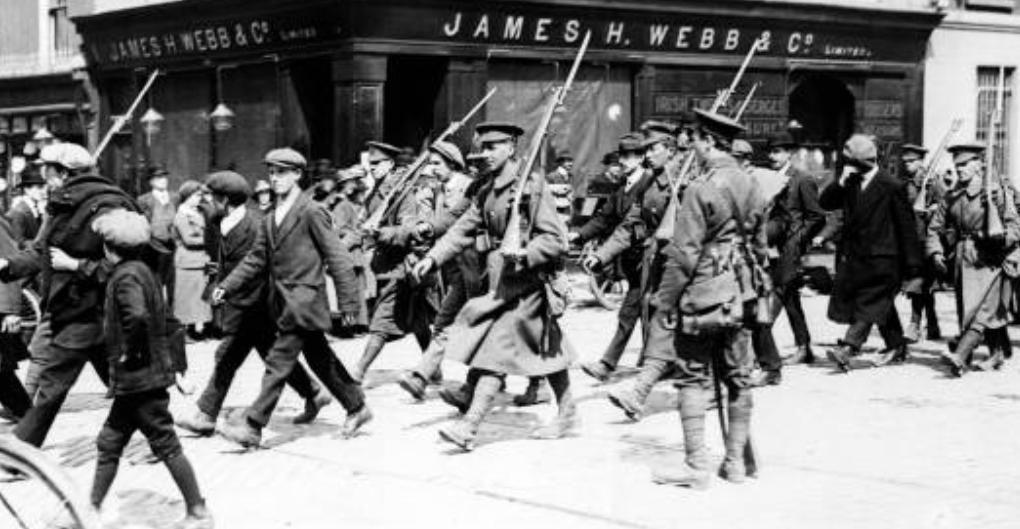
The socialist, organisers of workers for better rights and inspiration for a republica that gave equaity to everyone
James Connolly stands apart among the leaders of the 1916 Easter Rising—not only as a revolutionary, but as a thinker whose politics were rooted in the lived realities of working people. More than any of the seven signatories, Connolly fused nationalism with social justice, insisting that independence without economic equality was no independence at all. His life’s work, from trade union halls to battle-scarred Dublin streets, made him one of the most compelling and human figures of the rebellion.
Born into poverty and shaped by the hardships of working‑class life, Connolly developed a political worldview grounded in solidarity, fairness and the everyday struggle for dignity. His experiences as a labour organiser formed the backbone of his belief that political freedom must come hand‑in‑hand with social transformation. For Connolly, the Rising was never simply a bid to replace one flag with another—it was about reshaping the very structure of Irish society so that those at its margins could finally claim their place in the nation’s future.
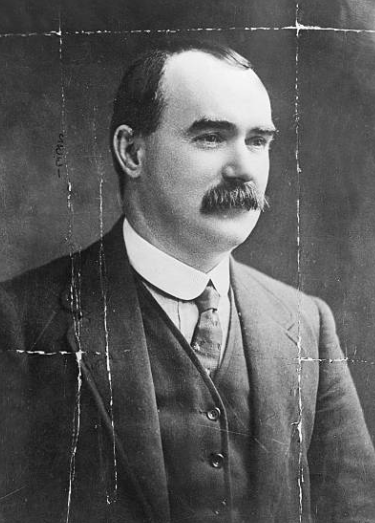
By the time he joined forces with the other signatories, Connolly had already become one of the most formidable labour leaders in Ireland. His role in the 1913 Lockout and his leadership of the Irish Citizen Army had confirmed his status as a fearless defender of workers’ rights. Yet what set Connolly apart was not just his readiness to organise, strike or fight; it was his deep intellectual conviction that the struggle for social equality was inseparable from the struggle for national freedom.
This fusion of ideals is what brought him into the fold of the Rising’s planners. While other leaders approached the rebellion from cultural, political or military angles, Connolly brought with him the perspective of those who felt the weight of inequality most acutely. His presence broadened the Rising’s purpose. It became not merely a bid for sovereignty, but a chance to create a republic that would serve all its citizens, not just the privileged few.
Connolly’s collaboration with the Irish Republican Brotherhood reflected both strategic necessity and ideological ambition. He recognised that labour alone could not secure the sweeping transformation he envisioned—but combined with the fervour of nationalist revolutionaries, it might. When he joined the military council, he did so as a man fully aware of the risks and with no illusions about the possible cost.
During Easter Week, Connolly’s leadership was defined by practicality and courage. As Commandant‑General of the Dublin forces, he coordinated much of the Rising’s defensive strategy, moving between outposts despite being injured early in the week. Those who served under him recalled a leader who remained calm, determined and unwavering—even as the situation around the GPO deteriorated. His tactical sense was widely respected, but it was his resolve that most marked his days in command. He understood that the rebellion might fail, yet he pressed forward with the knowledge that a symbolic victory could achieve what military success could not.
Connolly’s execution on 12 May 1916 was one of the most harrowing episodes in the aftermath of the Rising. Severely wounded, unable to stand, he was famously tied to a chair before being shot. His death shocked even some of those in the British administration, who believed that his condition should have spared him. In the eyes of the Irish public, it cemented him as a martyr—not only to the cause of independence, but to the cause of justice. His writings, his activism and his sacrifice became cornerstones of the emerging national consciousness.
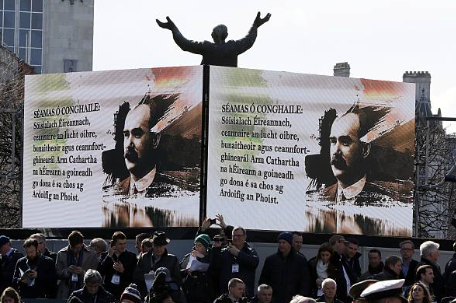
In the TG4 documentary series 1916 Seachtar na Cásca, available on the TG4 Player, Connolly’s story is told as part of the wider narrative of the seven signatories, each man’s path traced to that defining moment in the GPO. The series highlights Connolly’s unique position among the leaders—a revolutionary who carried the aspirations of Ireland’s working class into the heart of the Rising.
James Connolly remains a figure of profound moral and political weight. His vision of a republic rooted in equality has continued to challenge and inspire generations. Among the leaders of 1916, he is the one who most clearly reminds us that the fight for freedom is not merely about borders or flags—it’s about the lives and dignity of the people who live under them.
Leave a Reply